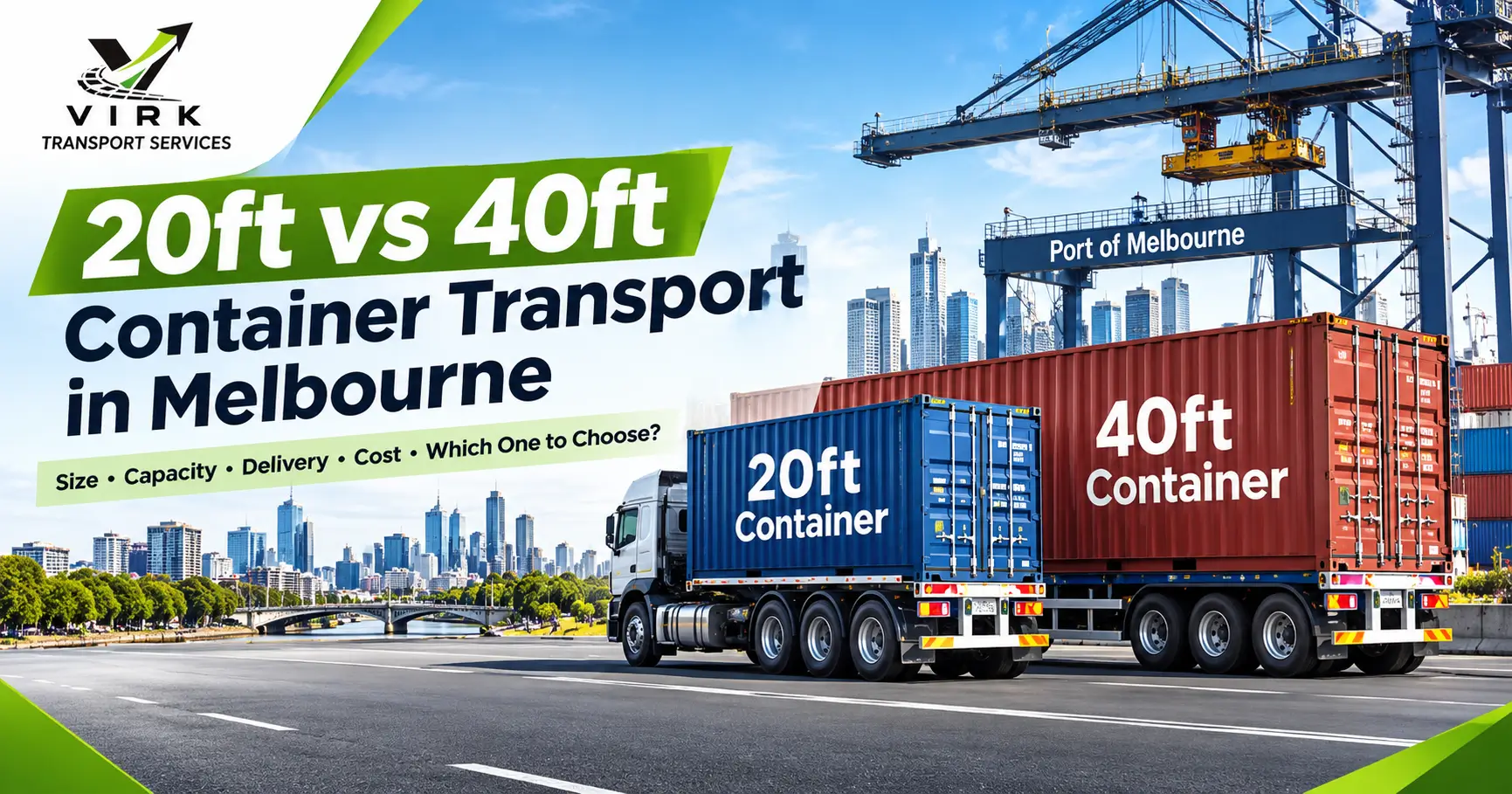
Choosing between a 20ft and 40ft shipping container is not just about size. The weight of your cargo, delivery location, site access and unloading method can all affect how your container is transported.
A 20ft container is often suitable for smaller shipments and heavy cargo, while a 40ft container provides more space for larger loads and bulky goods.
However, a larger container does not always mean a better or cheaper delivery.
This guide compares 20ft and 40ft container transport in Melbourne, including dimensions, weight considerations, delivery options and costs. It will help you understand what to check before arranging transport.
20ft vs 40ft Shipping Containers: Key Differences
Both container sizes are widely used for imports, exports and freight transport. The main differences are their length, internal space and handling requirements.
Feature | 20ft Container | 40ft Container |
External length | 6.06 metres | 12.19 metres |
External width | 2.44 metres | 2.44 metres |
External height | 2.59 metres | 2.59 metres |
Internal capacity | Approx. 33 m³ | Approx. 67 m³ |
Typical empty weight | Approx. 2.2 tonnes | Approx. 3.8 tonnes |
Best suited for | Smaller or dense shipments | Larger or bulky shipments |
Delivery space | Generally less | Generally more |
Transport cost | Depends on load and delivery | Depends on load and delivery |
Measurements are approximate for standard-height dry containers. Actual specifications vary by manufacturer and container type.
A standard 40ft container provides roughly twice the internal space of a 20ft container. However, it does not necessarily allow twice the cargo weight.
This difference matters when transporting heavy goods such as machinery, tiles, building materials and industrial equipment.
When Is a 20ft Container the Better Choice?
A 20ft shipping container is often a practical option for businesses transporting smaller shipments or heavy cargo.
It provides around 33 cubic metres of internal space and has a shorter footprint than a 40ft container.
Suitable cargo for 20ft containers
Common examples include:
- Tiles, stone and building materials
- Machinery and industrial parts
- Dense palletised goods
- Tools and construction equipment
- Smaller import and export shipments
A 20ft container can be a good choice when cargo weight matters more than the amount of space available.
For example, a shipment of heavy stone products may reach its permitted transport weight before filling the container.
In this situation, choosing a longer container may provide little benefit.
Read more: Reliable Container Transport Services in Melbourne
What to check before transporting a 20ft container
Before booking, confirm the total loaded weight, delivery address and unloading method.
A shorter container may be easier to position at some sites, but the truck still needs enough room to enter, turn and unload safely.
When Is a 40ft Container the Better Choice?
For shipping-line-owned containers, the empty container generally needs to be returned according to the shipping line’s instructions.
The return location may differ from the original collection terminal.
Confirm the nominated return facility, acceptance requirements and applicable deadlines before organising the final movement.
Suitable cargo for 40ft containers
Common examples include:
- Furniture and household goods
- Packaged retail products
- Lightweight manufactured goods
- Large commercial shipments
- Bulky machinery and equipment
- High-volume import and export cargo
A 40ft container can reduce the need to split a large shipment across multiple smaller containers, provided the cargo fits and weight limits are met.
However, the extra length can make delivery more challenging at sites with narrow entrances, limited turning space or restricted access.
What about 40ft high cube containers?
A 40ft high cube container has the same approximate length and width as a standard 40ft container but is taller.
Its external height is around 2.90 metres, compared with 2.59 metres for a standard container.
This extra height provides more internal space for tall or bulky goods.
When arranging transport, confirm whether the container is standard height or high cube. Height can affect route planning and site clearance.
Does a 40ft Container Carry More Weight Than a 20ft Container?
Not necessarily.
One of the most common misunderstandings is that a 40ft container can carry twice the weight of a 20ft container.
A 40ft container provides much more space, but its maximum permitted gross weight may be similar to that of a 20ft container.
The actual transport limit depends on the container specification, loaded weight, truck and trailer configuration, axle loads and applicable road rules.
Example: Heavy cargo versus bulky cargo
Consider two shipments.
Shipment A: Heavy building materials
A shipment contains dense tiles or stone products. The goods may fit comfortably inside a 20ft container but already approach the weight limit for the planned transport.
A 40ft container would provide more unused space without necessarily allowing more weight.
Shipment B: Lightweight packaged products
A shipment contains large cartons of relatively light products. It may fill a 20ft container before reaching its weight limit.
A 40ft container could be more suitable because it offers more room.
The key is to consider both cargo weight and cargo volume, not container length alone.
Read more: Port of Melbourne Container Transport: A Practical Guide for Importers and Exporters
Sideloader vs Standard Trailer: Which Delivery Method Do You Need?
The way your container is unloaded can be just as important as its size.
Two common options for container delivery in Melbourne are sideloader transport and standard trailer delivery.
Sideloader container delivery
A sideloader is a specialised trailer that can lift a container off the vehicle and place it on the ground beside the truck.
This option may be suitable when:
- The container needs to remain on-site for unloading
- Ground-level access is required
- The receiving location does not have suitable lifting equipment
- The site has enough space for the truck and lifting operation
Both 20ft and 40ft containers may be delivered using suitable sideloader equipment, subject to weight, access and equipment limits.
Sideloader delivery requires careful planning. The ground must be suitable for the equipment, and the driver needs enough space to position the truck safely.
Standard trailer delivery
A standard container trailer is generally suitable when the receiving site has the equipment and facilities needed to unload the container or its contents.
For example, a warehouse may unload goods while the container remains on the trailer, depending on the loading dock arrangement and available equipment.
A standard trailer does not normally place the container directly on the ground.
Which should you choose?
If you need the container placed on the ground, ask about sideloader delivery.
If your warehouse can unload directly from a trailer, a standard trailer may be a suitable option.
The final choice depends on the container weight, site layout, equipment and unloading requirements.
Read More: Sideloader vs Skel Container Transport: Which Do You Need?
What Affects 20ft and 40ft Container Transport Costs in Melbourne?
Container transport prices are not based on length alone.
A 40ft container does not automatically cost twice as much to transport as a 20ft container.
Several factors affect the final quote.
1. Delivery distance
The distance between the collection point and delivery address affects fuel use, travel time and vehicle availability.
2. Container weight
Heavy containers may require different equipment, route checks or additional charges.
3. Delivery method
Sideloader delivery and standard trailer transport involve different equipment and handling requirements.
4. Port and depot charges
For import and export containers, terminal charges, booking fees and empty container return arrangements may affect the total cost.
5. Site access
Difficult access, restricted operating hours or special delivery requirements can increase planning time and costs.
6. Waiting time
Delays during loading or unloading may lead to additional charges after any agreed free time has expired.
When comparing quotes, ask which services and charges are included rather than comparing only the base transport rate.
How Much Space Do You Need for Container Delivery?
Before booking a 20ft or 40ft container delivery, check whether the site can safely accommodate the truck and trailer.
A container may fit inside a property while the delivery vehicle cannot access it.
Important things to check include:
- Entrance width and height
- Turning space for the truck
- Overhead power lines, trees and structures
- Ground condition and slope
- Space beside the truck for sideloader operations
- Safe access for workers and unloading equipment
A 40ft container generally requires more room to position than a 20ft container.
However, there is no single access measurement suitable for every delivery. Requirements depend on the vehicle, trailer, load and site layout.
Practical tip: Send your transport provider photographs of the entrance and proposed container placement area before delivery.
This can help identify access problems before the truck arrives.
Five Things to Check Before Booking Container Transport
Use this checklist before arranging your delivery.
- Confirm the container size
Check whether you have a 20ft, 40ft or 40ft high cube container.
- Confirm the gross weight
Provide the total weight of the loaded container, including the container itself.
- Choose the unloading method
Decide whether you need ground placement or can unload the container while it remains on the trailer.
- Check the delivery site
Confirm that the truck can enter, manoeuvre and unload safely.
- Provide complete booking details
Share the container number, collection location, delivery address, preferred date and any site restrictions.
Having these details ready can help your transport provider prepare a more accurate quote.
Which Container Size Should You Choose?
The right container depends on what you are transporting and how it will be delivered.
Choose a 20ft container when:
- Your shipment is relatively small
- Your cargo is dense or heavy
- You do not need the extra space of a 40ft container
- The shorter container is better suited to your site
Choose a 40ft container when:
- You have a larger volume of goods
- Your cargo is bulky but relatively light
- You need more internal floor space
- Your delivery location can accommodate the longer container
If your cargo is unusually heavy, tall or difficult to handle, confirm the transport requirements before choosing a container.
The cheapest container option is not always the cheapest overall transport solution.
Arrange 20ft or 40ft Container Transport in Melbourne
Choosing the right container and delivery method can help avoid access problems, unnecessary handling and unexpected costs.
VIRK Transport Services provides container transport solutions in Melbourne, including 20ft and 40ft container movements.
If you need help planning a container delivery, share your container details, delivery address and unloading requirements.
Contact VIRK Transport Services to discuss your shipment and request a transport quote.
Frequently Asked Questions
A standard 40ft container is approximately twice as long and provides roughly twice the internal volume. It does not necessarily carry twice the cargo weight.
It can be, but not always. The price depends on distance, weight, equipment, collection charges and delivery requirements.
Yes, suitable sideloader equipment can handle both sizes. The container weight and delivery site must be checked before booking.
Yes. A suitable sideloader or other approved lifting equipment can place a 40ft container on the ground, provided the site and load are suitable.
A 20ft container is often suitable for dense cargo because it provides less volume while still allowing substantial payload capacity. The actual permitted weight must be confirmed for the container and road transport arrangement.
Provide the container size, total gross weight, collection and delivery addresses, preferred delivery date and unloading requirements. Site photos may also be useful.
It may be possible, depending on access, ground conditions, equipment, local restrictions and the container’s weight. A site assessment may be needed.