
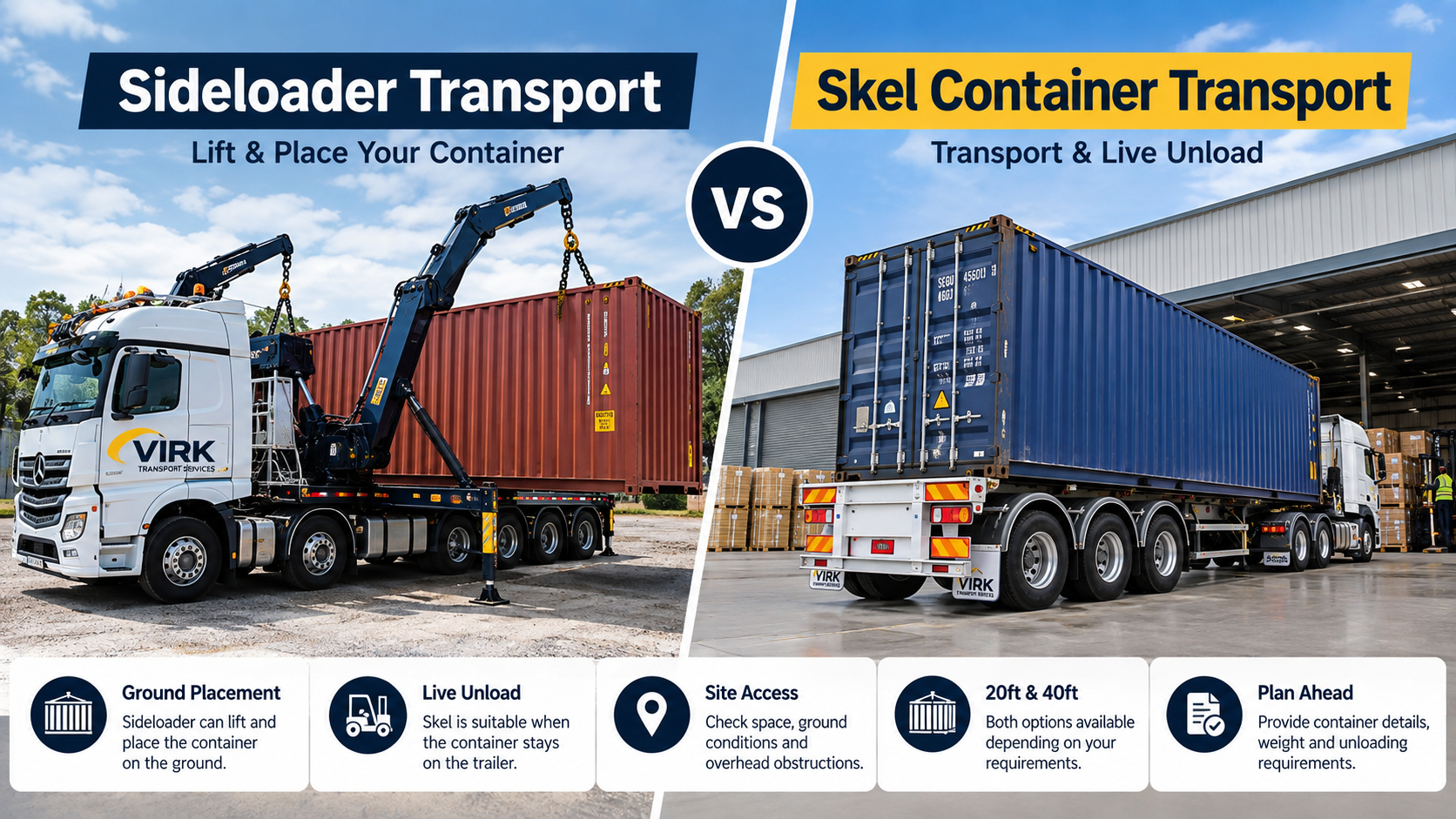
If you are arranging container transport in Melbourne, you may be asked whether you need a sideloader or a skel trailer.
For businesses that don’t move shipping containers every day, the difference isn’t always clear.
The simplest answer is:
Choose a sideloader when the shipping container needs to be lifted from the trailer and placed on the ground. A skel trailer is commonly used when the container can remain on the trailer while it is unloaded, or where suitable container-handling arrangements are available at the site.
But that isn’t the only thing you should consider.
Container size, weight, load distribution, unloading time, site access and what needs to happen to the empty container can all affect the transport plan.
At VIRK Transport Services, we provide sideloader and skel container transport across Melbourne and regional Victoria for import, export and other container movements.
This guide explains the practical differences and what you should check before booking.
Sideloader vs Skel: Quick Comparison
If you’re short on time, start here.
| Your Requirement | Usually Consider | Why |
|---|---|---|
| Container needs to be placed on the ground | Sideloader | Can lift a suitable container from the trailer to the ground |
| Warehouse will complete a live unload | Skel | Container can remain on the trailer |
| No container-lifting equipment onsite | Sideloader | Provides its own container lifting capability |
| Need the container left onsite for later unpacking | Sideloader | Allows ground placement where conditions are suitable |
| Fast warehouse unload | Skel | Suitable when ground placement isn’t required |
| 20ft container | Either | Depends on weight and unloading requirements |
| 40ft container | Either | Depends on weight and unloading requirements |
| Restricted or difficult site | Assessment required | Access and operating conditions must be checked |
| Heavy container | Assessment required | Weight and load distribution matter |
| Unsure which trailer is required | Ask before booking | Avoid sending unsuitable equipment |
The key question is not simply whether your container is 20ft or 40ft.
Ask:
What needs to happen to the container when the truck arrives?
What Is Sideloader Container Transport?
A sideloader is specialised container transport equipment designed to lift a suitable shipping container between the trailer and the ground.
This means the truck can transport the container and, where site and operating conditions allow, place it on the ground without requiring separate container-lifting equipment at the delivery site.
Sideloader transport can be useful for businesses that need time to unpack their container or do not have equipment capable of removing the complete container from a trailer.
A typical import sideloader movement could be:
Port or depot → Customer → Container placed on ground → Customer unpacks → Empty container collected → Empty dehire
Suitable sideloader equipment can be used for both 20ft and 40ft container transport, subject to the weight, load, equipment and conditions of the particular job.
When Should You Choose a Sideloader?
A sideloader may be the right option when the container needs to be placed on the ground.
There are several common situations where this is useful.
You Need the Container on the Ground
This is the clearest reason for using a sideloader.
If the complete shipping container needs to come off the trailer, a standard skel trailer cannot perform that ground-placement operation by itself.
You Need More Time to Unpack
Not every customer can unload a shipping container quickly.
If your business needs the container left onsite for an agreed period, a sideloader may allow the container to be placed on the ground and collected later.
This can avoid keeping a truck and driver onsite throughout a long unloading process.
You Don’t Have Container-Lifting Equipment
A forklift used for unloading pallets or cargo from inside a container is not necessarily capable of lifting the complete shipping container.
A sideloader provides its own specialised container-handling capability.
You Need the Empty Container Collected Later
Once the container has been unpacked, a return movement can be arranged to collect the empty container and take it to the nominated empty container park or dehire location.
What Is Skel Container Transport?
A skel, or skeletal trailer, is designed specifically for carrying shipping containers.
The container is secured to the trailer during transport.
Unlike a sideloader, however, a standard skel does not have equipment to lift the complete shipping container from the trailer and place it on the ground.
Skel transport is commonly used when the container can remain on the trailer at the delivery location.
A typical warehouse movement could look like:
Port → Warehouse → Live unload while container remains on trailer → Truck departs with empty container → Empty dehire
This can work well for warehouses and distribution facilities that are set up to unload containers efficiently.
When Should You Choose a Skel Trailer?
A skel may be appropriate when you do not require ground placement.
You’re Completing a Live Unload
A live unload means the container arrives on the truck, remains on the trailer while the customer unloads the cargo, and then leaves with the truck.
If your warehouse can complete the unload within the agreed time, this can be an efficient transport arrangement.
Your Warehouse Is Set Up for Container Deliveries
Businesses regularly receiving containers may already have suitable loading areas, forklifts, staff and procedures for unloading containers while they remain on the trailer.
In this situation, there may be no reason to place the complete container on the ground.
You’re Moving a Container Between Suitable Facilities
Skel trailers can also be used for appropriate point-to-point container movements where ground placement isn’t required.
What Is the Main Difference Between a Sideloader and a Skel?
The most important difference is container handling at the delivery site.
A sideloader can lift a suitable container between the trailer and the ground.
A standard skel trailer carries the container but does not provide its own ground-placement capability.
Think about it this way:
Need the complete container on the ground? → Consider a sideloader.
Container can stay on the trailer? → A skel may be suitable.
That simple question can prevent many booking problems.
Real Example: 40ft Import Container From the Port of Melbourne
Consider a business receiving a 40ft import container from the Port of Melbourne for delivery to a warehouse in Melbourne’s western suburbs.
There are two possible situations.
Scenario 1: Warehouse Can Complete a Live Unload
The warehouse has staff and forklifts ready.
The container arrives and remains on the skel trailer.
The warehouse unloads the cargo within the agreed time, and the driver then leaves with the empty container.
A skel may be suitable because ground placement isn’t required.
Scenario 2: Customer Needs More Time to Unpack
The same customer cannot unload the complete container during a live delivery.
Instead, the container needs to be left onsite for an agreed period.
In this situation, a sideloader may be required to place the container on the ground, subject to suitable site conditions.
After the customer finishes unpacking, the empty container can be collected for dehire.
The important point is that both examples involve the same 40ft shipping container.
The unloading requirement changes the transport equipment needed.
Sideloader vs Skel for a 20ft Container
Both sideloader and skel equipment can be used for suitable 20ft container movements.
Don’t choose the trailer simply because the container is 20ft.
Instead, determine:
- Is the container loaded or empty?
- What is the container weight?
- Does it need to be placed on the ground?
- Can the customer complete a live unload?
- What are the site-access conditions?
- What needs to happen after unloading?
If ground placement is required, discuss sideloader transport.
If the container can remain on the trailer, a skel may be suitable.
Sideloader vs Skel for a 40ft Container
The same principle applies to a 40ft shipping container.
If the container needs to be placed on the ground, discuss a suitable sideloader movement.
If it can remain on the trailer during unloading, a skel may be the more appropriate option.
However, container length is only one part of planning the movement.
Weight, load distribution, access and unloading requirements also matter.
Why Container Weight and Load Distribution Matter
One of the most important details to provide your transport company is accurate container weight information.
But total weight is not the whole story.
How cargo is distributed inside the container can also affect transport and handling.
For example, a container with a large amount of weight concentrated toward one end can create different handling considerations from a container where the load is distributed correctly.
This is particularly important for businesses packing export containers.
Don’t simply load all heavy cargo into one section of the container without considering weight distribution and load restraint requirements.
If the container contains unusually heavy cargo or concentrated loads, tell your transport provider before collection.
Never wait until the truck arrives to disclose important weight or load information.
What We Check Before a Sideloader Delivery
A sideloader booking should involve more than asking whether the container is 20ft or 40ft.
For an unfamiliar delivery site, useful information can include:
- Container size
- Container weight
- Delivery address
- Site entrance
- Available operating area
- Proposed container position
- Ground conditions
- Overhead obstructions
- Container door direction
- Nearby vehicles or equipment
- Other access restrictions
If site access could be difficult, send clear photographs before the delivery.
Photos of the entrance, driveway and proposed container position can help identify obvious problems before the truck arrives.
Sideloader Site Access: What Should You Check?
A sideloader requires suitable operating conditions to safely transfer a container.
Before booking, check for potential problems such as:
Narrow Gates or Entrances
The truck and trailer need suitable access to enter, operate and leave the site.
Parked Cars
Vehicles parked near the proposed delivery area can interfere with access or operating space.
Powerlines
Overhead powerlines are a serious consideration when planning container handling.
Trees and Building Structures
Trees, awnings, roofs and other overhead or nearby structures may affect the available operating area.
Ground Conditions
The proposed operating and container-placement area needs to be suitable for the planned operation.
Container Door Direction
Decide where the container needs to sit and which way the doors should face before delivery.
Don’t wait until the truck is onsite to start planning the container position.
Common Mistakes When Booking Container Transport
A little planning can prevent significant delays.
Here are some common problems that can occur.
1. Booking a Skel When You Actually Need Ground Placement
If the container must be placed on the ground, tell the transport provider when requesting the quote.
Don’t assume every container truck can unload the complete container.
2. Assuming Every Site Is Suitable for a Sideloader
A sideloader can provide ground placement, but it still requires suitable access and operating conditions.
Send site information before booking if there is any doubt.
3. Providing Container Size but Not Weight
Saying “it’s a 40ft container” does not provide all the information required to plan every job.
Provide accurate weight information as well.
4. Forgetting About Empty Container Dehire
For an import movement, the job may not finish when the container reaches your warehouse.
Once unpacked, the empty container may need to be returned to a nominated dehire location within the required timeframe.
Plan this part of the movement as well.
5. Not Planning the Unloading Time
A live unload and a container ground drop are different transport operations.
Tell the transport company how you intend to unload before the equipment is allocated.
6. Sending Site Information After the Truck Has Been Dispatched
If the site has restricted access, don’t wait until delivery day to mention it.
Early information makes transport planning easier.
What Information Do We Need for a Container Transport Quote?
Providing complete information from the beginning helps the transport provider assess the job and allocate appropriate equipment.
Before requesting a quote, have the following information ready where applicable:
Container Details
- Container number
- 20ft or 40ft
- Loaded or empty
- Gross weight
- Any unusual load considerations
Transport Details
- Pickup location
- Delivery address
- Import, export or local movement
- Required delivery date
- Required delivery time
Unloading Details
- Live unload
- Ground placement
- Container drop and later collection
- Other handling requirements
Site Details
- Access restrictions
- Proposed container position
- Ground conditions
- Relevant photographs
After Delivery
- Empty container collection required?
- Empty dehire location known?
- Container needs to move somewhere else?
Providing this information early can reduce unnecessary delays and equipment changes.
What Happens During an Import Container Movement?
An import container movement can involve several stages.
A typical movement may include:
Container becomes available → Terminal slot/collection planning → Port collection → Customer delivery → Unloading → Empty collection → Empty dehire
The exact process depends on the shipment and delivery requirements.
This is why the unloading method should ideally be confirmed before the container is collected.
If the customer later discovers that ground placement is required but a skel has been allocated, the transport plan may need to change.
What About Export Container Transport?
Export container transport works in the opposite direction, but equipment selection is still important.
A typical export movement may involve:
Empty container pickup → Delivery to exporter → Container loading → Loaded container collection → Export terminal
If the empty container needs to be placed on the ground while it is packed, a suitable sideloader arrangement may be required.
If the container can remain on a trailer during loading, another transport arrangement may be suitable.
Plan this before the empty container is collected.
Read More: Reliable Container Transport Services in Melbourne
Is Sideloader Transport More Expensive Than Skel Transport?
There is no single answer for every job.
Container transport pricing can depend on:
- Pickup location
- Delivery location
- Container size
- Container weight
- Equipment required
- Port or terminal requirements
- Tolls
- Waiting time
- Ground placement
- Additional movements
- Empty dehire location
- Regional travel
A sideloader uses specialised container-handling equipment, so the rate structure can differ from standard skel transport.
However, choosing equipment based only on the lowest initial price can be a mistake if that equipment cannot complete the required job.
The better question is:
Which transport method can complete the entire container movement safely and efficiently?
Sideloader or Skel? Use This Simple Decision Guide
Choose a Sideloader When:
You need the complete shipping container placed on the ground.
It may also be appropriate when you need additional time to unpack the container or don’t have suitable equipment to remove the complete container from the trailer.
Choose a Skel When:
The container can remain on the trailer during unloading and ground placement isn’t required.
This is common for warehouse live unloads.
Not Sure?
Don’t guess.
Provide the transport company with:
Container size + weight + pickup + delivery address + unloading method + site information.
The job can then be assessed using the actual transport requirements.
Need Sideloader or Skel Container Transport in Melbourne?
The choice doesn’t need to be complicated.
If the container needs to be placed on the ground, discuss a sideloader.
If the container can remain on the trailer during unloading, a skel may be suitable.
For more complex movements, don’t select equipment based only on container size or price.
Consider the complete job: container size, weight, load distribution, site access, unloading method and what needs to happen after delivery.
VIRK Transport Services provides 20ft and 40ft container transport across Melbourne and regional Victoria, including sideloader and skel transport, import and export container movements and empty container dehire movements.
For a transport quote, provide your container details, weight, pickup location, delivery address and unloading requirements so the appropriate transport option can be assessed.
Frequently Asked Questions
A sideloader has specialised equipment that can transfer a suitable shipping container between the trailer and the ground. A standard skel trailer transports the container but does not provide the same self-unloading ground-placement capability.
Suitable sideloader equipment can transport 40ft containers. Container weight, load requirements, equipment capacity and site conditions need to be considered for the individual movement.
Suitable sideloader equipment can also transport 20ft containers. Weight, positioning and the requirements of the specific movement should still be confirmed.
A standard skel trailer does not have the specialised lifting equipment required to transfer the complete container from the trailer to the ground. If ground placement is required, discuss a sideloader or another suitable handling solution.
Not necessarily.
A forklift used to unload pallets or cargo from inside a shipping container is different from equipment capable of lifting the complete container.
If the container can remain on the trailer while your warehouse unloads it, a skel may be suitable.
Not necessarily.
If the container can remain on the trailer and your site can complete the unload within the agreed arrangement, skel transport may be suitable.
There isn’t one measurement that should be applied to every job. Required operating space depends on the vehicle, equipment, container, placement position and site conditions.
If access is restricted, provide site details and photographs before booking.
Yes. Container weight and how the load is distributed are important considerations when planning transport. Provide accurate weight and load information before collection.
This depends on the transport arrangement. Where empty dehire is included in the job, the transport provider can collect or transport the empty container to the nominated dehire location according to the agreed movement.
Provide the container size, weight, pickup location, delivery address, import/export status, required date, unloading method and relevant site-access information. For sideloader jobs, photographs can also help when access or placement is restricted.